Clean Customs Brokerage Entry CSV Files Before a Port Delay Review
6/21/2026
Clean Customs Brokerage Entry CSV Files Before a Port Delay Review
Port delay reviews become unreliable when customs brokerage exports are inconsistent. Container IDs may include extra spaces, milestone dates may use different formats, and hold codes may appear in several variations across brokers or lanes. If the file is not cleaned first, the review team spends its time arguing over records instead of finding the shipments that actually need intervention.
The fix is simple: standardize the entry data before the delay meeting.
What Usually Shows Up in Customs Entry Exports
| Field type | Common issue | Review impact |
|---|---|---|
| Container or bill number | Formatting drift, prefixes, spacing | Rows fail to match carrier or port records |
| Entry submission date | Mixed date formats | Delay aging becomes unreliable |
| Hold or inspection code | Similar codes written differently | Exception counts are split across categories |
| Port and terminal names | Abbreviations vs full names | Lane-level summaries look fragmented |
| Release status | Missing or stale values | Team cannot separate active risk from resolved files |
If these fields are normalized before the meeting, the review becomes much easier to trust.
A Practical Cleanup Sequence
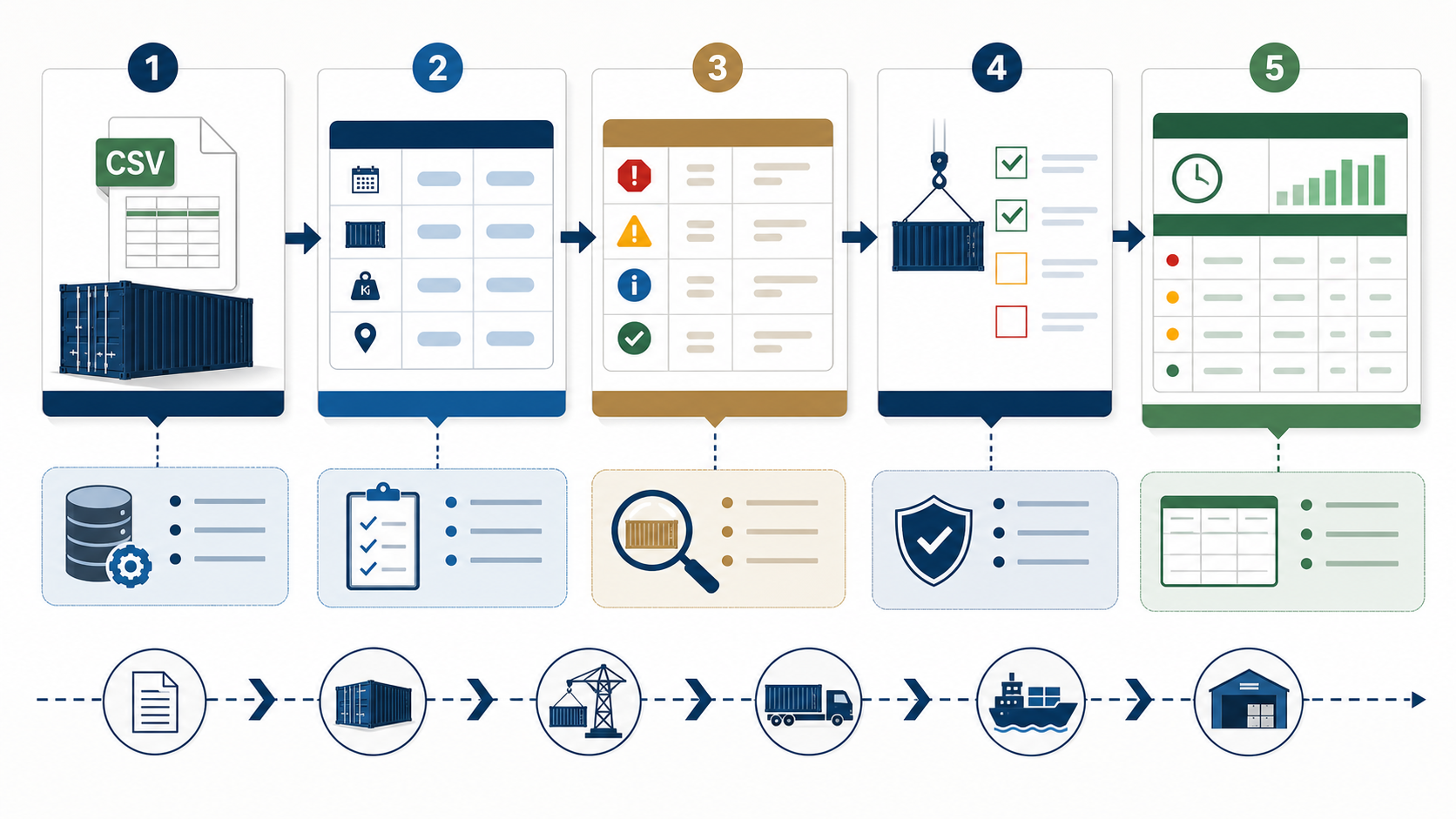
- Import the raw brokerage exports for the review window.
- Trim and standardize shipment identifiers.
- Convert all date columns to one format.
- Map hold codes and release statuses to a common vocabulary.
- Flag missing container IDs, missing release dates, and duplicate entries.
- Build one exception table for active delayed shipments.
This is especially important when the review combines broker files, port milestone files, and carrier status exports.
Example Exception Table
| Container | Port | Hold category | Days delayed | Release status | Action owner |
|---|---|---|---|---|---|
| FSCU4421903 | Long Beach | Documentation hold | 4 | Pending | Brokerage team |
| TGHU7710281 | Savannah | Inspection hold | 7 | Pending | Import operations |
| MEDU1134589 | Newark | Missing release date | 3 | Unknown | Carrier coordinator |
| TEMU6023147 | Houston | Duplicate entry rows | 2 | Review needed | Data analyst |
Checks to Run Before the Meeting
| Check | Why it matters |
|---|---|
| Missing shipment identifiers | Prevents blind spots in the exception list |
| Duplicate entry numbers | Avoids double-counting delay exposure |
| Invalid date order | Catches impossible sequences such as release before filing |
| Unmapped hold codes | Keeps categories readable for operations teams |
| Blank release status | Highlights records that need follow-up before the call |
When to Separate Active Risk From Cleanup Risk
Not every issue in the export is an operational delay. Some issues are simply data quality defects.
| Record type | Better treatment |
|---|---|
| Real port hold with clean identifiers | Keep in the active delay review |
| Duplicate row with same container and timestamp | Remove or collapse before reporting |
| Missing release date but confirmed released elsewhere | Fix or annotate before counting |
| Unknown hold code from one broker | Map to standard category or isolate for follow-up |
That distinction helps the team focus on shipments that truly need intervention.
Text Flow
Raw brokerage exports
        |
Identifier cleanup
        |
Date standardization
        |
Hold-code mapping
        |
Duplicate and missing-field checks
        |
Final delayed-shipment review table
Common Mistakes
- Treating every broker export as if it uses the same column names.
- Counting blank release statuses as confirmed delays without validation.
- Leaving container IDs in mixed formats before joining carrier files.
- Mixing historical resolved holds into the current review packet.
Who Benefits From This Workflow
This process is useful for import operations managers, customs coordinators, brokerage teams, and analysts who prepare daily or weekly delay reviews. It is especially helpful when several external partners feed the same meeting but no one can guarantee that their export structures will match.
Review Checklist
- One row per shipment in the final exception table.
- One standard date format across every source export.
- One agreed vocabulary for hold categories and release statuses.
- One separate bucket for data defects that are not true operational delays.
Download DataOlllo
If customs and port review files still need manual cleanup before every delay meeting, try a local workflow with DataOlllo: download DataOlllo.