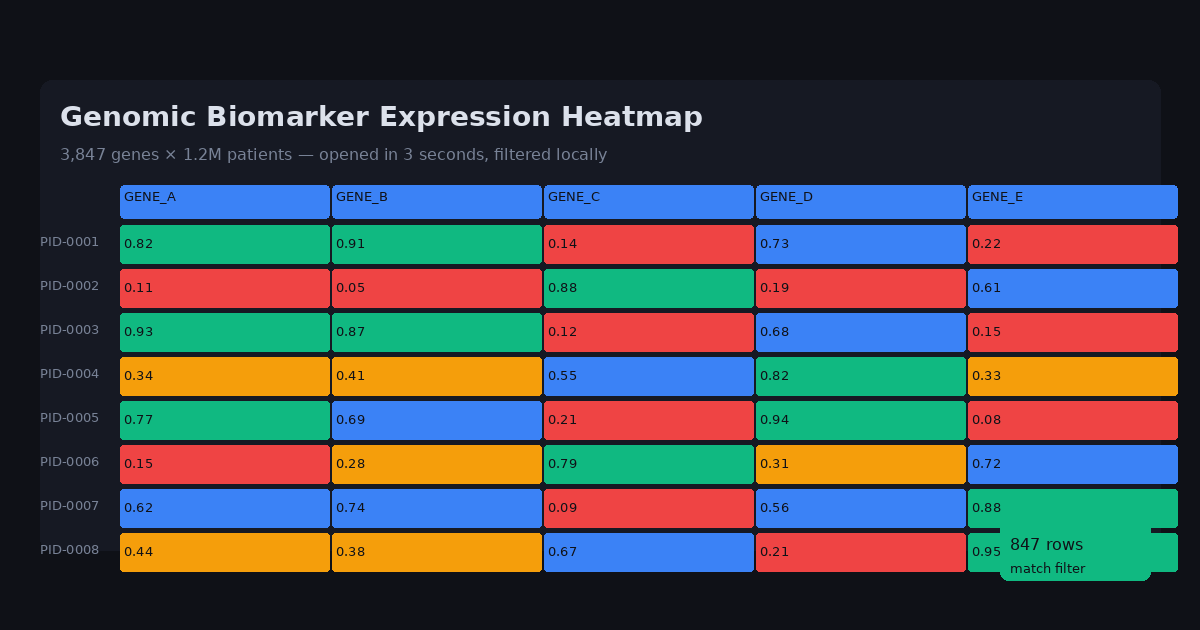
Fast Genomic Data Filtering Techniques for Large-Scale Life Sciences Research
5/25/2026
Life sciences researchers work with some of the widest and deepest datasets in any scientific field. A genomic variant dataset might track thousands of biomarkers across hundreds of thousands of patient genomes. A proteomics or transcriptomics dataset can easily have columns for each gene or protein measured across thousands of clinical trial samples.
The Scientific Challenge
In genomic research, you routinely need to filter variant calling files (VCF) or clinical exports to isolate specific genetic cohorts. But loading a dataset with 5 million rows and 3,000 columns into traditional spreadsheet tools is impossible. Standard spreadsheets either clip the columns or freeze and crash instantly due to RAM overhead.
Bioinformatics tools like Python, R, or custom command-line utilities (bcftools, plink) are highly capable but have a steep learning curve for laboratory staff, require intensive setup, and can still run out of memory when loading entire datasets into pandas DataFrames.
Cloud-based genomics platforms solve the computation limits but raise serious data governance issues: your proprietary clinical trials, patient genomes, and therapeutic insights must be uploaded to external servers, risking privacy and intellectual property compliance.
Practical Genomic Data Filtering Workflow
DataOlllo addresses these challenges with a local-first, memory-efficient columnar data engine designed to handle extremely wide datasets on standard research workstations.
Step 1: Open the wide dataset instantly
Rather than loading the entire file into memory at once, DataOlllo streams columns from disk as needed. You can open files containing thousands of columns and millions of rows in seconds.
Step 2: Manage thousands of columns visually
Use DataOlllo's column navigator to see a complete directory of your variables. You can search for specific gene labels or biomarkers and toggle their visibility. Hidden columns are excluded from active processing, reducing memory usage to a fraction.
Step 3: Perform multi-variant filtering
Filter down to target mutations or patient demographics. You can combine multiple logic conditions—such as isolating variants on Chromosome 7 with an allele frequency below 0.05 and a high quality score—and see the filtered dataset update in real time.
Step 4: Group and aggregate by cohort or treatment
Apply GroupBy aggregations to compare cohorts. For example, calculate average expression levels of specific marker genes grouped by treatment response or tumor grade.
Step 5: Export clean subsets for downstream tools
Once your cohort is defined and cleaned, export it as a standard CSV or tab-delimited file ready for immediate import into statistical packages like R, SPSS, or specialized bioinformatics pipelines.
Why DataOlllo for Life Sciences
- Unrestricted Column Widths: Process UK Biobank, clinical trial, or phenotype data with 3,000+ columns without horizontal lag or page crashes.
- Local Data Security: Keep sensitive patient data, cohort definitions, and genomic discoveries entirely within your secure local environment—complying with IRB protocols and data sovereignty laws.
- Accessible to All Researchers: Enable laboratory technicians and clinical coordinators to perform complex data filtering, querying, and sorting without writing SQL, R, or Python scripts.