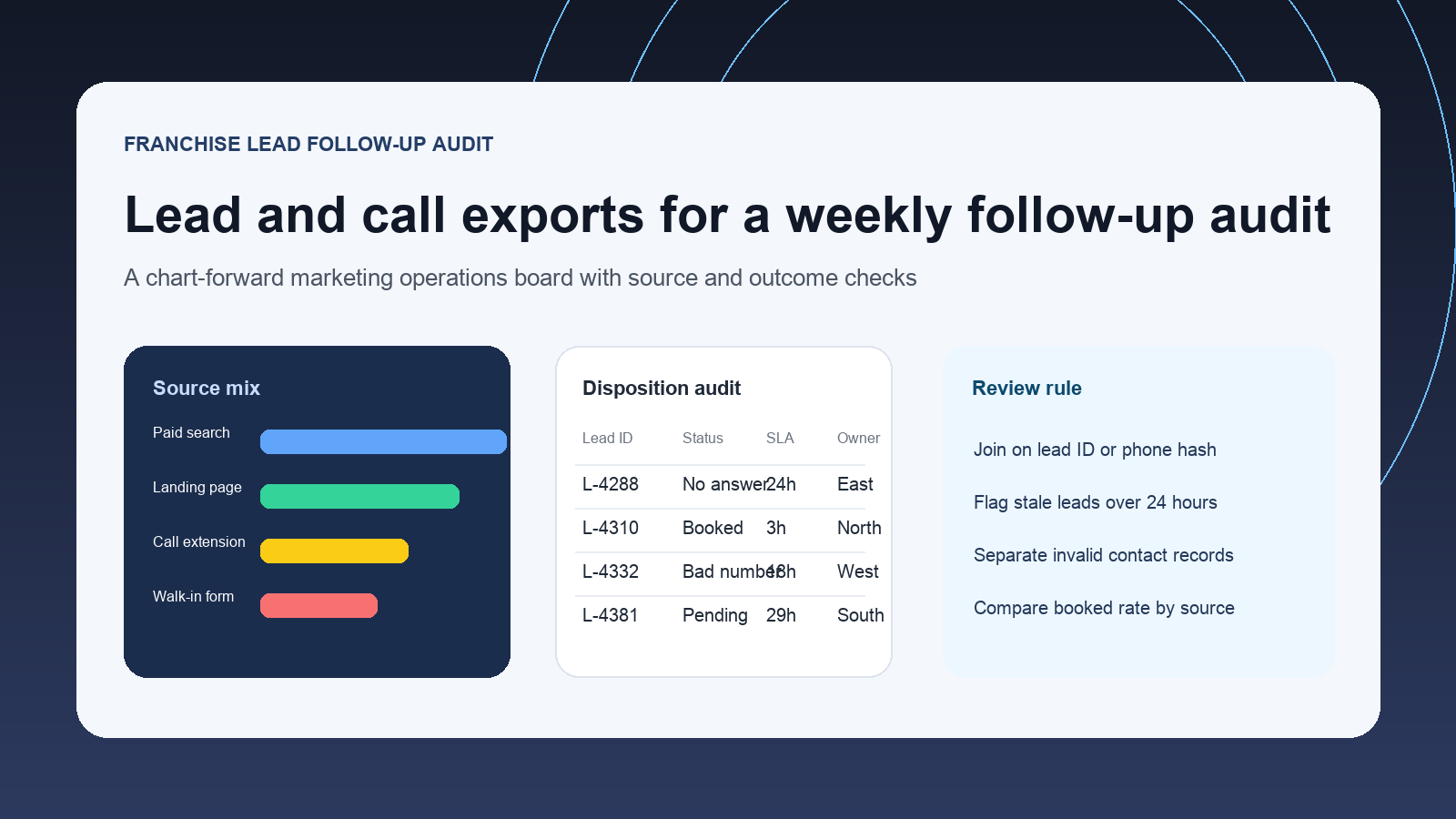
Merge Lead Form and Call Disposition CSV Exports Before a Franchise Follow-Up Audit
6/23/2026
Franchise teams often know how many leads were generated, and they usually know how many calls were completed. The hard part is proving whether each lead received a timely follow-up. That answer lives across separate exports: lead form submissions, call center dispositions, and sometimes booking outcomes from local branches.
If those files are reviewed separately, the weekly audit becomes a debate about ownership instead of a clear look at response quality.
Start with stable matching keys
| Candidate key | Use it when | Watch out for |
|---|---|---|
| Lead ID | Shared across intake and call systems | Missing when manual entries bypass the lead form |
| Phone hash or normalized phone | Call outcome file lacks lead ID | Duplicates from repeat inquiries |
| Email plus date window | Branch intake is partially manual | Shared inboxes or typo-heavy forms |
When possible, match with one primary key and keep a fallback key for unresolved rows. Mixing keys too early can create false matches that look cleaner than the real data.
The weekly audit sequence
1. Clean the lead source names
Branches and agencies often send slightly different source labels for the same channel. Normalize those names first so booked-rate comparisons are meaningful.
2. Convert call dispositions into a short taxonomy
A long list of statuses is harder to review than a small set such as:
BookedNo answerInvalid contactNot interestedPending follow-up
That structure makes it easy to see whether weak performance is a response-speed problem, a contact-quality problem, or a handoff problem.
3. Flag leads that exceeded the response standard
The most useful audit rows are not the completed successes. They are the leads that sat too long without action.
| Lead source | Leads received | Leads over 24h without contact | Booked rate | Review note |
|---|---|---|---|---|
| Paid search | 182 | 21 | 18% | Follow-up lag in two territories |
| Landing page | 96 | 9 | 24% | Stable |
| Call extension | 57 | 14 | 11% | Check local routing |
| Referral page | 41 | 3 | 29% | Strong conversion quality |
What to look for in the mismatch set
- Leads present in intake export but absent from call outcomes
- Calls logged without a matching lead record
- Invalid phone or email values concentrated in one source
- Branches with high pending-follow-up counts and low booked rates
- Repeated inquiries from the same contact that inflate raw lead totals
Present the audit by owner, not just by channel
A pure channel summary can hide operational gaps. If one territory or branch repeatedly leaves leads untouched, leadership needs that view directly. Add owner or franchise unit to the review so responsibility is visible.
Why local review matters
Lead exports may include contact details, call notes, local branch routing information, and internal outcome labels. A local workflow keeps the audit private while still allowing the team to join larger CSV exports, inspect mismatches row by row, and compare response patterns across franchise locations.
Next step
If your weekly lead audit still relies on separate channel and call reports, merge them into one local operating view first. DataOlllo can help you clean source names, join lead and call exports, and isolate stale follow-up rows before the meeting. Download it here: https://www.dataolllo.com/download